How to Find a Reliable Metal Parts Manufacturer in 2026?
Finding a reliable supplier in 2026 requires more than comparing unit prices. Metal Parts Manufacturing now depends on traceability, process control, engineering communication, and dependable delivery. A polished website proves very little.
Deloitte’s 2025 Manufacturing Industry Outlook identifies supply-chain resilience, digital transformation, and workforce capability as major manufacturing priorities. Its earlier smart manufacturing research found that 92% of surveyed executives viewed smart manufacturing as important for future competitiveness. These findings matter when evaluating a metal parts manufacturer. A capable supplier should explain how it controls CNC machining, stamping, casting, surface finishing, and inspection data. Ask for sample inspection reports, material certificates, equipment lists, and realistic production timelines.
Quality evidence should remain specific. ISO’s 2023 Survey recorded more than one million ISO 9001 certificates worldwide, but certification alone cannot guarantee consistent parts. Request process capability data, calibration records, corrective-action examples, and references from comparable projects. Examine the details: a clearly labeled first-article report, a measured bore diameter, or a shipment packed against corrosion can reveal more than a sales presentation.
Do not ignore communication.
Reliable manufacturers disclose limitations early. They question unclear tolerances instead of accepting every drawing silently. They also explain capacity risks, tooling ownership, minimum order quantities, and backup plans. McKinsey’s manufacturing research continues to emphasize resilience and supplier visibility, yet many sourcing teams still overvalue the lowest quotation. That is an understandable mistake. It is also expensive.
The best decision combines documented quality, technical judgment, transparent communication, and verified delivery performance. Leave room for reflection, because no supplier scorecard is perfect. Recheck assumptions before signing a long-term agreement.
Define Your Metal Parts Requirements and Quality Standards
A reliable metal parts manufacturer starts with a clear understanding of your requirements.
Before requesting quotes, define the part’s function, material grade, surface finish, and expected service conditions. Include dimensions, tolerances, thread details, heat treatment, and corrosion concerns. A simple drawing with datum references prevents costly assumptions. Do not write “tight fit.” Specify where fit matters. Add prototype quantities, annual volume, packaging needs, and delivery windows.
Quality standards must be measurable.
For a machined part, identify critical dimensions and their inspection methods. For a stamped component, define burr limits, flatness, and acceptable deformation. State the sampling level for production checks. Ask for material certificates, dimensional reports, and process records when appropriate. A photograph is not proof. Request sample inspection data from comparable parts, while protecting confidential information. Calipers may confirm length, but they cannot verify hardness or coating thickness.
During technical discussions, observe whether the manufacturer reviews your drawing carefully.
A capable team should question unclear tolerances, unrealistic finishes, or missing reference surfaces. Some specifications will be wrong. That is normal. Revise them after prototype testing, not after mass production begins. Confirm traceability, change control, equipment calibration, and procedures for handling nonconforming parts. These details often reveal reliability more clearly than a low quotation.
Compare Manufacturing Processes, Materials, and Production Capabilities
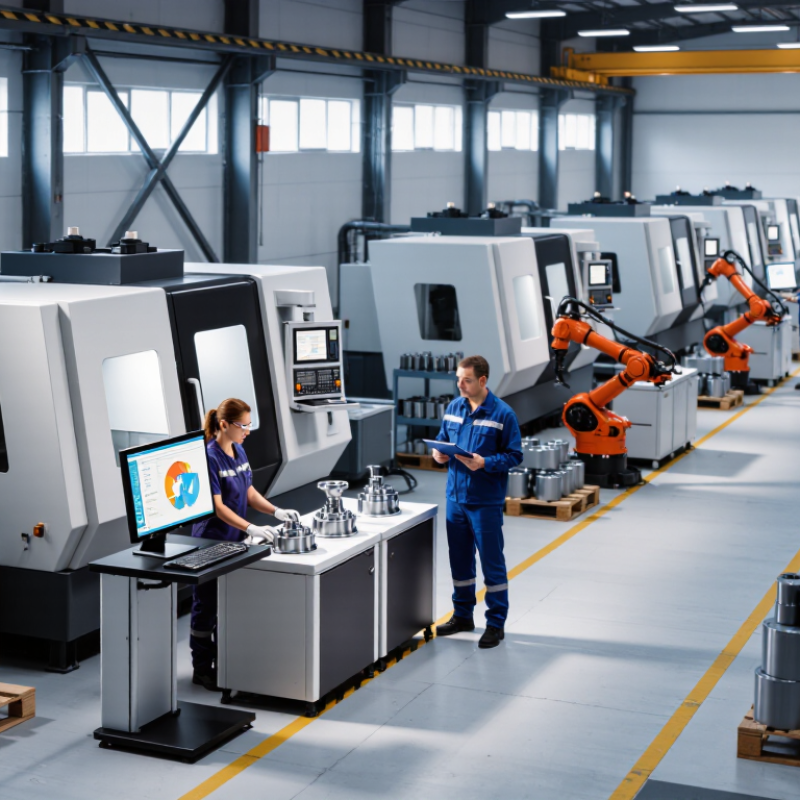
A reliable metal parts manufacturer in 2026 should match its process to your part, not force every order through one method. CNC machining suits tight tolerances, complex prototypes, and low-volume production. Stamping can reduce unit costs for large batches with repeatable shapes. Casting works well for complex forms, while laser cutting handles flat profiles quickly. Ask for sample inspection reports, process photographs, and measured tolerances from similar projects.
Material selection deserves equal attention. Aluminum offers low weight and corrosion resistance, while stainless steel supports demanding environments. Carbon steel may lower costs, but surface protection can become necessary. Copper alloys support electrical conductivity and heat transfer. Confirm the material grade, supplier certificate, hardness range, and traceability system. A polished sample can hide weak internal controls. I have seen attractive first parts fail when production volume increased.
Tips: Compare equipment lists with your drawings. Check maximum part size, machine accuracy, tooling capacity, and monthly output. Request a small pilot batch before approving full production. Review inspection methods, including coordinate measuring machines and surface-finish testing. Ask how the manufacturer handles nonconforming parts. Their answer often reveals more than a sales presentation. Also check communication speed and engineering support. A supplier may own advanced machines yet lack practical process planning. That mistake is easy to miss.
How to Find a Reliable Metal Parts Manufacturer in 2026?
Compare representative dimensional capabilities across common metal manufacturing processes. Lower tolerance values indicate tighter typical precision.
The values represent practical industry benchmark midpoints in millimeters and can vary with part geometry, material, equipment, inspection methods, and supplier qualification. CNC machining commonly supports aluminum, steel, stainless steel, brass, and titanium; laser cutting and press forming are widely used for steel and aluminum sheet; die casting is suited to aluminum, zinc, and magnesium alloys; investment casting supports complex stainless-steel and nickel-alloy parts; and metal additive manufacturing is useful for complex stainless-steel, tool-steel, titanium, and nickel-alloy components. A reliable manufacturer should provide process-specific tolerances, material certificates, inspection reports, and scalable production capacity.
Verify Manufacturer Credentials, Equipment, and Quality Systems
How to Find a Reliable Metal Parts Manufacturer in 2026?
Verify Manufacturer Credentials, Equipment, and Quality Systems
A reliable supplier should show more than a polished website. Request business registration, current quality certificates, insurance details, and recent customer references. Confirm that certificate scopes cover machining, forming, or finishing needed for your parts. Ask who audits the system and when the certificate expires. Small details matter.
Review the factory floor, in person or through a live video tour. Look for machine capacity, material storage, tool control, and visible calibration labels. Ask for maintenance records on CNC machines, presses, furnaces, and measuring equipment. A capable manufacturer should explain tolerances without guessing. Request sample inspection reports, including dimensions, surface finish, hardness, and material heat numbers. Do not accept attractive samples alone.
Quality systems reveal daily discipline. Check how the supplier handles incoming inspection, first-article approval, in-process checks, final release, and nonconforming parts. Traceability should connect material certificates to production lots and shipping records. Ask for corrective-action examples, not just procedures. A certificate proves intent, not consistent performance. No system is flawless. Even a careful audit can miss rushed paperwork or an overlooked worn tool. Include a pilot order with agreed acceptance criteria, inspection points, and response times. Review the results openly, including defects and delays. Reliability grows from evidence, transparent communication, and the willingness to fix uncomfortable problems.
Evaluate Pricing, Lead Times, Communication, and Supply Reliability
Finding a reliable metal parts manufacturer in 2026 requires more than comparing the lowest quotation. Request a line-by-line price breakdown covering material, tooling, finishing, inspection, packaging, and freight. A cheap quote can hide expensive revisions. Ask which assumptions could change the price. Confirm whether tolerances, alloy certificates, and sampling are included. An experienced buyer should compare at least three comparable offers, not three different specifications. That matters.
Lead times deserve the same scrutiny as prices. Ask for separate dates for order confirmation, material arrival, first articles, production, and shipment. A supplier promising ten days may be less reliable than one promising fifteen. Request recent on-time delivery data, capacity evidence, and a written response to late-material risks. I once accepted a confident schedule without checking raw-material availability. The parts arrived late. That mistake changed my process. Now, I ask what happens when a machine fails or inspection rejects a batch.
Communication becomes measurable when questions receive clear owners and deadlines. During sampling, note response times, revision control, drawing access, and escalation contacts. A capable manufacturer explains problems with measurements, photographs, and corrective actions. Vague reassurance is not a quality system. Supply reliability also depends on backup machines, approved material sources, maintenance records, and realistic production capacity. Do not accept documents blindly; verify certificates and sample dimensions against your requirements. My checklist is useful, but it is not perfect. Pressure reveals weaknesses. Regularly review delivery, defects, and communication to identify problems before they affect production.



 +86 180 0293 5268
 CONTACT Shixin
 CONTACT Shixin
 CONTACT Shixin